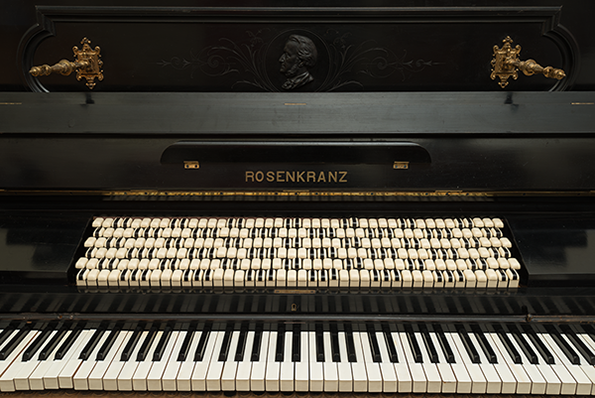

UPRIGHT PIANO
experimental design,
cross-strung
215-stringed (12 single strings and
sixteen 2-string wound choirs, fifty
seven 3-string unwound choirs)
2 keyboards, 340-keyed (85 keys
in the traditional piano keyboard and
255 keys in the keyboard of P. von
Janko system)
(keyboards extent is А of the double
contra octave — a of the four-line
octave)
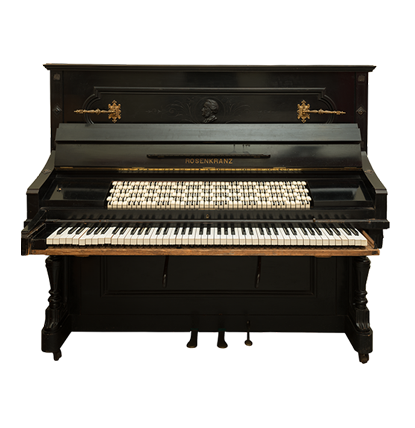
E. Rosenkranz’ Factory, No. 13027.
Germany, Dresden, 1889
“D.R.R. 25282 32138 LICENZ Lic. – Nr. 159 [the numbers are handwritten] / zur Anfertigung einer / JANKO-CLAVIATUR / im Deutschen Reiche. / Nur giltig für die Pianofabrik: Ernst Rosenkranz, Dresden [the name and the city are handwritten] / Claviaturfabrik: … [an unfilled blank in the original] Instrumentengattung: … [an unfilled blank in the original] / Der Patentinhaber: Paul Janko [further Janko’s signature] / Dieser Licenz … [further text is illegible due to gaps in the paper] ist am In / strumente von an … [further text is illegible due to gaps in the paper] sichtbar zu / befestigen, sonst … [further text is illegible due to gaps in the paper] als / rechtswidrig (sic!) erze … [further text is illegible due to gaps in the paper] ständet. / Leipzig, 22 Januar 1889 [the date is handwritten] / Expedition / der / Zeitschrift für Instrumentenbau [“Expedition” and further — a stamp by blue dye]” — a paper printed and handwritten label glued to the inner surface of the right side bar;
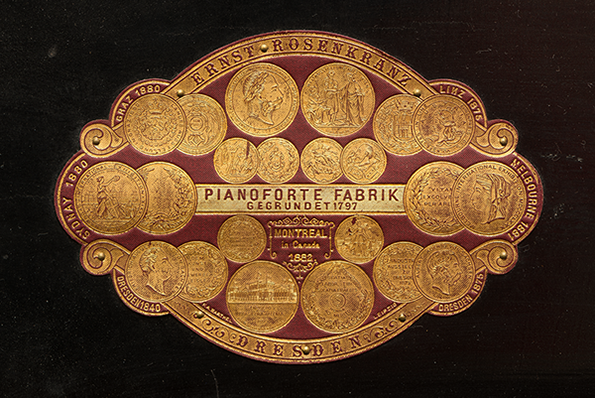
Below are the images of the front and back sides of 11 medals received by the Rosenkranzʼ Factory at International exhibitions, line by line: «GRAZ 1880 [Wien 1873] LINZ 1875 / [TEPLITZ 18…] [the last numbers are illegible] / SYDNAY 1880 MELBOURNE 1881 / Ausstellung 1881 zu HALLE MONTREAL in Canada 1882 [the inscription is not on the medal] / DRESDEN 1840 EXPOSICAO BRASILEIRA ALLEMA 1881 DRESDEN 1875 / [further printed inscription: “F. A. BARTHEL DRESDEN”] [the inscriptions between the medals]: ERNST ROSENKRANZ / PIANOFORTE FABRIK / GEGRUNDET (sic!) 1797 / DRESDEN” — a stamping by golden paint on the leather label issued by F. A. Barthel’s printing house (?) in Dresden (the label is nailed with ornamental studs to the inside of the upper cover of the case);
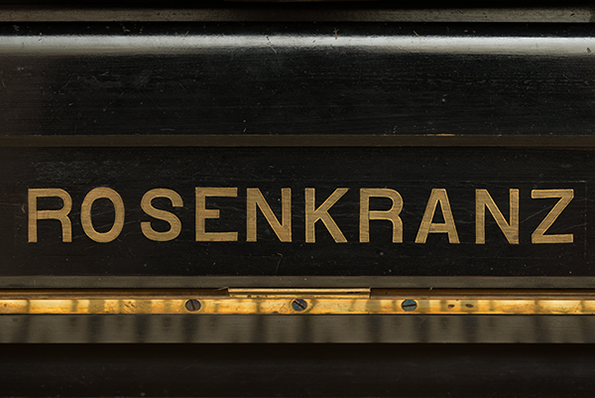
“ROSENKRANZ” — a cast inscription on the frame (area of the tuning pegs of the descant register;
“ROSENKRANZ” — inlaid with brass in the lid;

1458×1310×860
Wood, metal, bone, fabric, felt
1912, purchased from Z. V. Butorina
Stock number: 16516/748

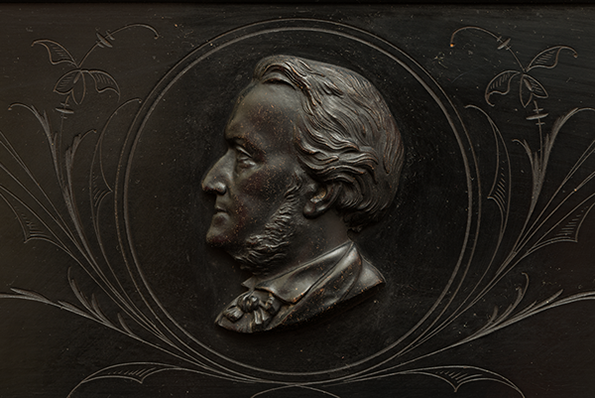
The frame is cast iron. The key action is hoppered. Both keyboards have a common hammer mechanism. The keyboard of P. von Janko’s system (1856–1919) is 6-lined stepped (ladder-like). The piano is equipped with the “harmoniopiano” invented by V. I. Glavach (1849–1911), which is a pneumatic mechanism for acquiring tremolo. There are 3 pedals; the 3rd pedal is designed to control the mechanism providing tremolo sound. The upper front side is decorated with plated carving (a profile of R. Wagner) and 2 bronze candlesticks.